Revealed: More Than a THIRD of Americans are Supporting Another Country Instead of USMNT at the World Cup

The 2026 World Cup is underway on US soil, the first time the tournament has been held in the country since 1994, and a generation has grown up since. But so has the way Americans attach themselves to the game.
To map that shift, the team at Freebets conducted a survey of 1,800 US adults, asking which foreign team they have adopted as their second side, then mapping the most popular pick in every state. The result is a landscape of borrowed allegiances, with heritage ties, influencers, and favorite players causing a shift in loyalties.
And for more than a third of Americans, and nearly half of Gen Z, that second team is really their first, the side they want to win ahead of the USA squad.
The Key Takeaways
- More than a third of Americans (36%) plan to back a foreign team rather than the USA, rising to nearly half of Gen Z (49%).
- Mexico is the most-adopted non-US team, topping 16 states, including California, Texas, Florida, and New York
- Three-quarters of Gen Z in that group (74%) say a celebrity, influencer or athlete shaped which country they are backing
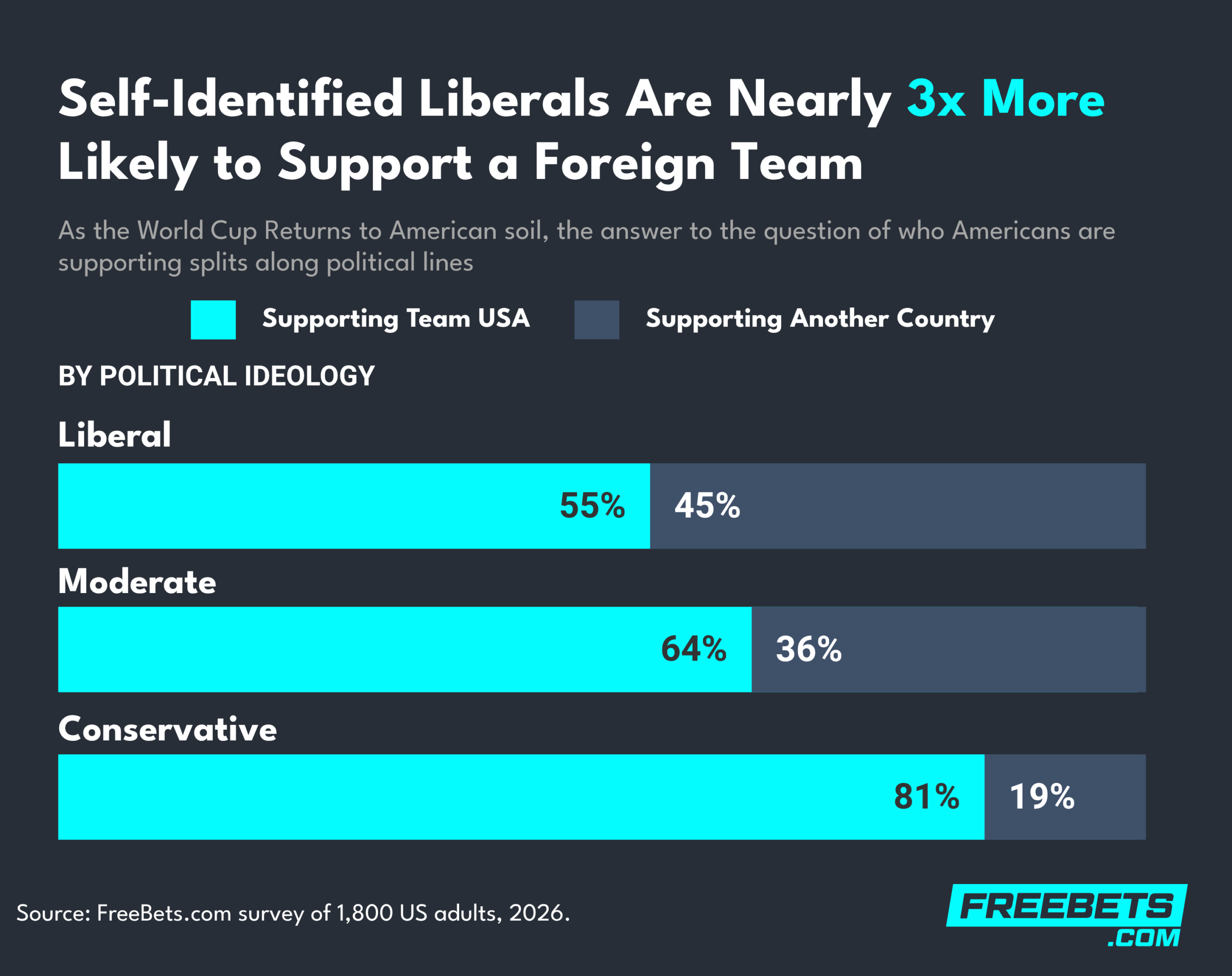
- The choice is sharply partisan: 45% of self-identified liberals back another country versus just 19% of conservatives
- One in six adopters (16%) would stop watching if their team is knocked out of the tournament
A Third of America Is Rooting for the Other Side
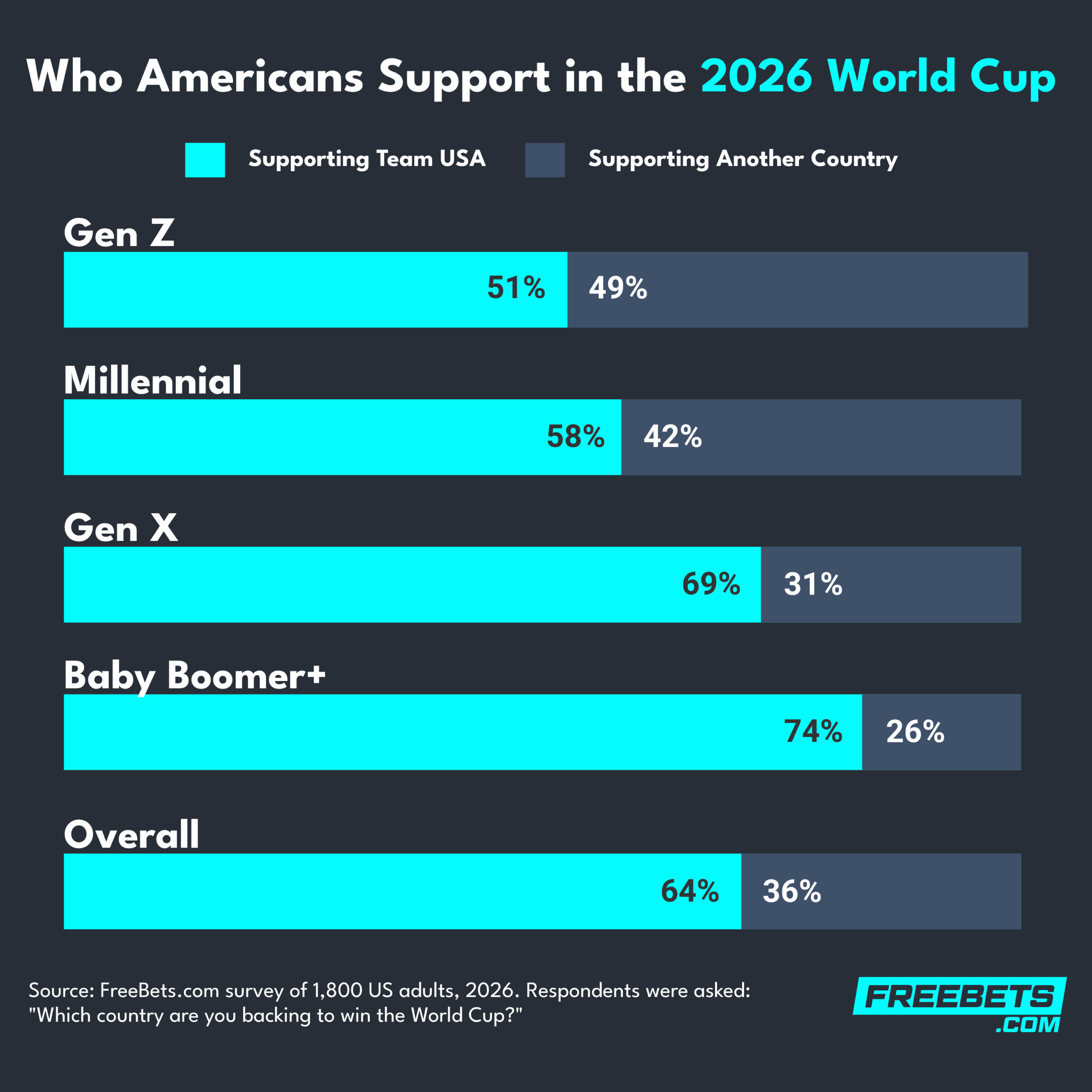
More than a third of Americans (36%) say they want a foreign team to win the 2026 World Cup over the USA, and as the group stages play out on home soil, that number is not a fringe position. Among the youngest adults in the country, Gen Z, 49% are backing another country to win, making them the only generation where wanting a foreign team to lift the trophy outnumbers wanting the USA to do it. Millennials are close behind at 42%. The drop-off comes with age: Gen X sit at 31% and boomers and older at 26%, less than half the Gen Z rate.
The generational gap is not just about which team they picked, it is about how connected different generations feel to being American in the first place. Older Americans arrive at the tournament with a strong default: back the home side. That sense of national identity converts directly into who they cheer for. Among Gen Z, that connection is weaker, and the sporting allegiance follows. A generation that feels less attached to American identity is, in measurable numbers, less attached to the American team, even when that team is playing in their own backyard.
The Star-Power Generation: Young Fans Pick Teams Like They Pick Celebrities
It is not only that younger fans are likelier to back another country, it’s how they got there. Where older fans tend to inherit an allegiance, the youngest increasingly follow one, and the survey shows exactly who is doing the pulling.
- Family history or ancestry — 22.6%
- Fandom of a specific player — 20.3%
- Playing style — 11.5%
- Support from a celebrity or influencer I follow — 10.9%
- Their culture or general vibe — 8.5%
- A friend, partner, or family member supports them — 8.4%
- The kit or how they look — 7.3%
- Underdog appeal — 6.4%
How they chose that team looks different too. Among those backing a foreign team to win, nearly three-quarters of Gen Z (74%) say a celebrity, influencer or athlete shaped which country they back, with 31% saying it mattered "a lot." Among boomers in the same group, the figure is one in eight (12%). The reasons split along the same line: Gen Z lead with a specific player (21%) ahead of heritage (18%), while boomers lead with heritage (28%) ahead of a specific player (20%). For the oldest fans the allegiance was inherited; for the youngest it was followed.
Every State's Second-Favorite Team at the 2026 World Cup
Looking at the most popular non-USA team in each state, it’s clear Mexico’s following is a fan force to be reckoned with, topping 16 states, including California, Texas, Florida, New York, Illinois, Arizona, New Jersey, North Carolina, Pennsylvania, Virginia, and Maryland. That reach is no accident. Heritage is the single most common reason Americans give for following a foreign team, and Mexico is the primary beneficiary, among Hispanic respondents who name a second side, 43% choose Mexico, a connection rooted in ancestry rather than any passing trend.
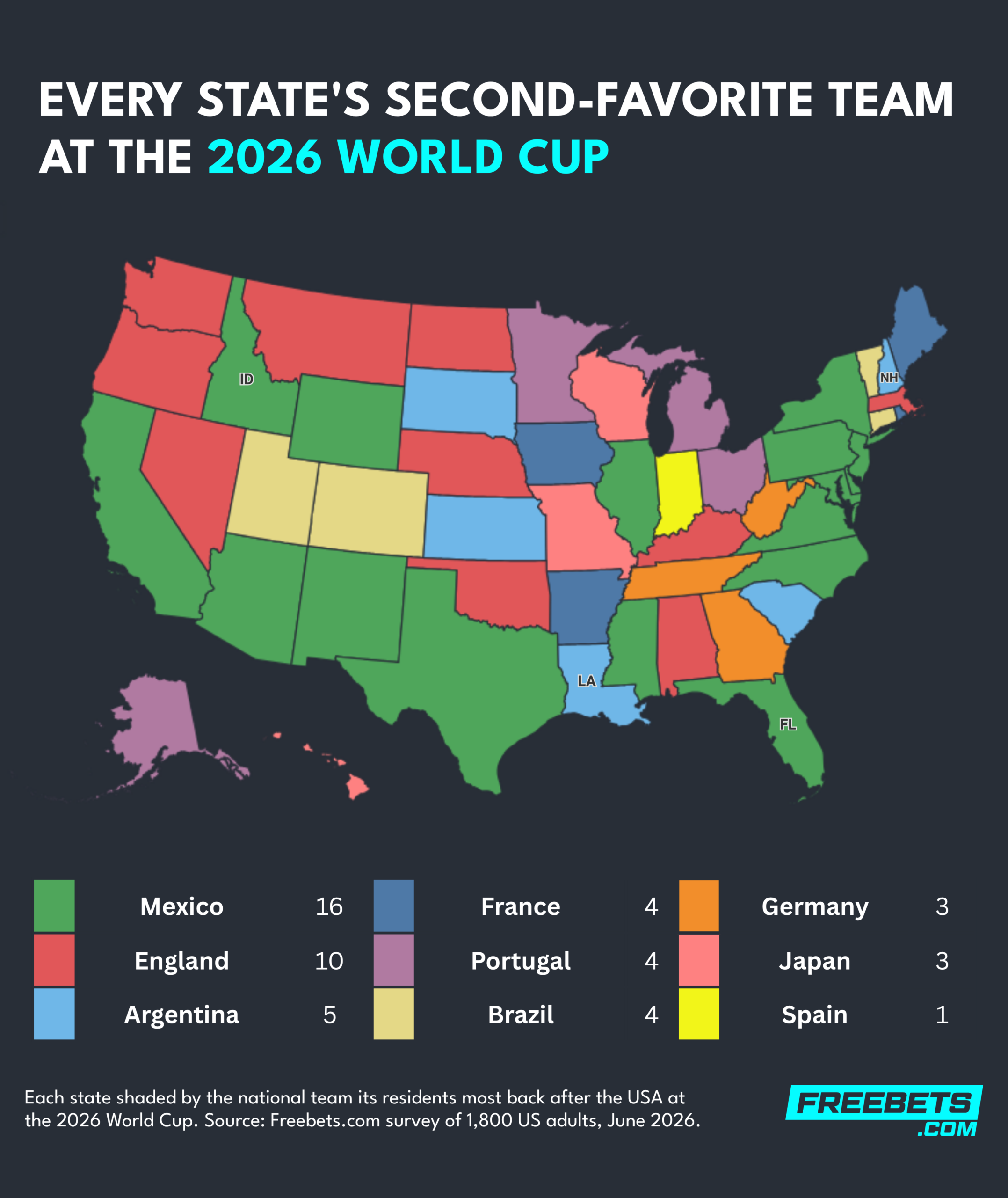
England comes second, leading in 10 states. Argentina is next with 5, followed by France, Portugal, and Brazil each on top in four states, Germany and Japan three apiece, and Spain one. Where the heritage pull toward Mexico is weaker, the pick turns on a player or a style of play. Argentina's five states track the Messi effect as cleanly as any data point in the survey. Portugal's four reflect a combination of heritage and the global reach of Cristiano Ronaldo. Japan's three — Missouri, Wisconsin, and Hawaii — are a mixed picture: Hawaii's strong Japanese-American heritage community makes it a natural fit, while Missouri and Wisconsin point more to a fanbase built on players and style rather than ancestry.
The Political Fault Line
Allegiance splits along political ideology similarly as it does with age. Nearly of self-described liberals (45%) plan to back a foreign team, against 36% of moderates and just 19% of conservatives.
Asked whether the political climate has changed how they feel about the US team, a quarter of Americans (25%) say it makes them want to support the team less, while 18% say it increases their support. As for why, about a quarter cite something tied to politics or patriotism for skipping the USA: 15% say politics has put them off the US team, and 12% say they do not feel patriotic about the country right now.
For Love of the Game
Whatever divides Americans at this particular moment in history, something remarkable is happening in living rooms, sports bars and backyard gatherings across the country this summer. People are watching. They are learning the names of players they had never heard of, picking out kits, arguing about tactics, and staying up late for matches. A tournament that started as a question about loyalty has revealed something simpler: a nation with an enormous capacity for enthusiasm, for finding a team to love, for caring deeply about a beautiful game that belongs to everyone.
Methodology
This survey was conducted in June 2026 among a survey pool of 1,800 Americans who plan to follow the World Cup, with 66% identifying as men, 33% as women, and 1% as non-binary. The median age of respondents was 34 years.
If you fancy betting on a match in progress, be sure to check out our dedicated review page of the best betting sites curated by our expert team, as well the latest World Cup 2026 odds and free bet offers available.