
New Gambling Commission Harm Data Fuels Affordability Debate



The Gambling Commission has published fresh evidence on how gambling harms are experienced across Britain, and the timing could hardly be more significant.
Released on 16 July 2026 as two secondary analysis reports, the Adverse Consequences from Gambling package arrives as the debate around affordability checks intensifies, with both supporters and critics likely to point to the findings.
The first report, Measuring Gambling Related Harm: Validating a Summary Metric of Potential Adverse Consequences, examines whether reporting one or more potential adverse consequences is a reliable population-level measure of gambling harm.
The Commission concludes that it is.
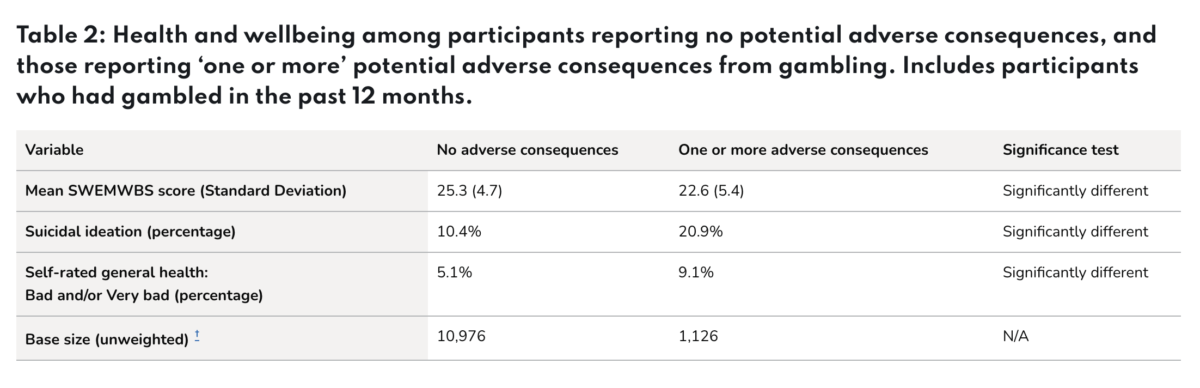
People reporting one or more consequences had poorer mental well-being, worse self-rated health, and were almost twice as likely to report suicidal thoughts or attempts as those reporting none, even after accounting for demographic differences.
New Gambling Commission Harm Data Fuels Affordability Debate
The second report, Exploring Demographic Differences in Adverse Consequences from Gambling, is likely to attract the most attention.
It found that both potential and severe gambling harms were most common among men, younger adults, people identifying as Mixed, Asian or Black compared with White participants, and those on lower incomes.
The most striking finding relates to low-risk gamblers.
Among people with a PGSI score of 1, ethnic minority participants had an 11.8% predicted probability of reporting one or more potential adverse consequences compared with 5.5% for White participants.
That gap narrowed at 3, with 32.3% versus 24.1%, before disappearing altogether at 8, with White participants at 95.6% versus 91.9% for ethnic minorities.
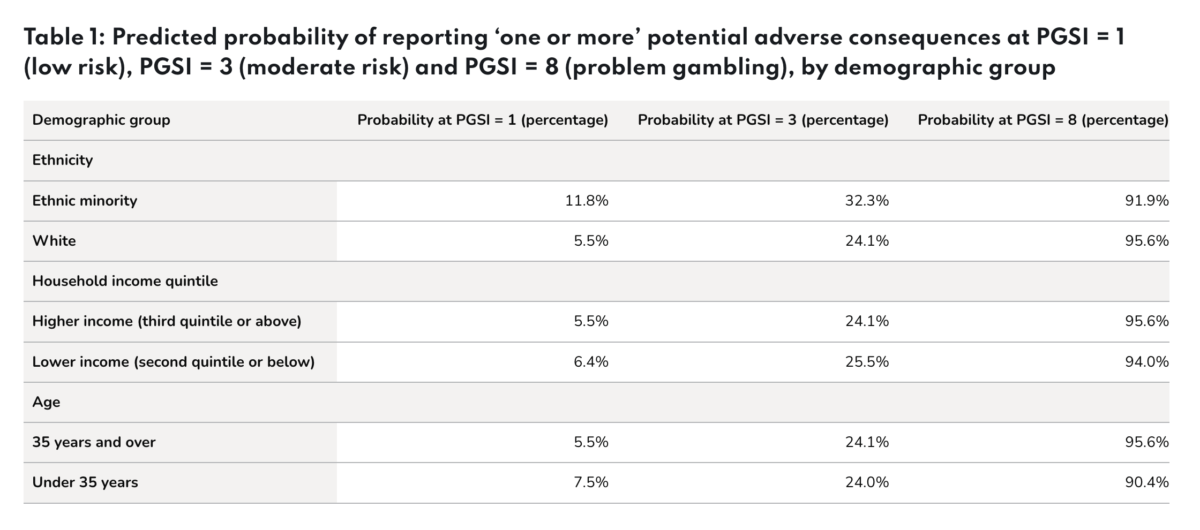
The Commission concludes that PGSI scores alone do not tell the full story.
Two people with identical scores can experience very different levels of real-world harm depending on factors such as income, age and ethnicity, meaning consequences should be monitored alongside behavioural risk scores rather than replacing them.
The wider context is also important.
On the same day, the Commission published its third annual GSGB report, putting the PGSI 8-plus problem gambling rate at 2.4% of adults in 2025, down slightly from 2.7% the previous year.
Executive Director Tim Miller described three years of GSGB data as "an important milestone" in understanding gambling's impact on people's lives.
The political backdrop is impossible to ignore.
On 7 July, the Commission confirmed the phased introduction of Financial Risk Assessments, beginning with customers aged 25 or over who make net deposits of £5,000 or more within 24 hours.
The regulator says fewer than 0.5% of customers exceed that threshold, while pilot testing found that 97% of assessments could be completed without customer intervention.
We covered the changes in our affordability checks explainer.
Just days later, the Culture, Media and Sport Committee demanded further evidence on the policy by 24 July, while industry groups renewed concerns that the Gambling Survey for Great Britain oversamples gamblers and overstates participation and harm.
That tension sits at the heart of these reports.
Consumer protection groups are likely to see the demographic findings as further evidence that gambling harm disproportionately affects younger, lower-income and minority communities, strengthening the case for greater intervention.
Industry bodies, meanwhile, will continue to question whether broad population-level survey findings should be used to justify account-level affordability checks.
Even the Commission's own independent reviewer has urged policymakers to interpret the figures with appropriate caution.
Our own betting and trends survey reflects that divide.
Of more than 1,200 UK punters surveyed, around a third said affordability checks had made their betting experience worse, while only a small minority believed they had improved it.
Most criticism centred on intrusive document requests rather than the principle of safer gambling measures.
Nothing changes for punters today.
But these reports will form a significant part of the evidence shaping the next phase of UK gambling regulation, and they are likely to feature prominently when the Culture, Media and Sport Committee reports back later this month.
You may have noticed through reading this article and the surveys posted on the Gambling Commission's website, that there's no mention of the harms of the black market in their annual survey.
And this hasn't gone unnoticed on social media:
Indeed, it's surprising for us too. For any serious policy discussion on the regulated gambling sector must factor in second order consequences, especially when players can be tempted into the black market with more attractive welcome offers vs their regulated counterparts.
We'll keep monitoring developments and reporting. Want to share your thoughts on the Gambling Commission's survey? Leave us a comment below.